Chapter 12.3
ch12.3
12.3-1
TREE-INSERT(T, z)
    x = T.root
    if x == NIL
        T.root = z
    else TREE-INSERT-REC(x, z)

TREE-INSERT-REC(x, z)
    if z.key < x.key
        if x.left == NIL
            x.left = z
        else TREE-INSERT-REC(x.left, z)
    else if x.right == NIL
             x.right = z
         else TREE-INSERT-REC(x.right, z)
12.3-2
To search for a value in the tree, we need to perform one more test—from the parent to the desired node, than first insertion of the value into the tree.
12.3-3
The worst-case is when the \(n\) numbers are already sorted, the running time will be \(O(n^2)\), the best-case is when the \(n\) numbers make the tree balance, the running time will be \(O(n\lg n)\).
12.3-4
The operation of deletion is not commutative. Below is the example, deletion of \(1\) then \(2\) will generate a different tree than deletion of \(2\) then \(1\).
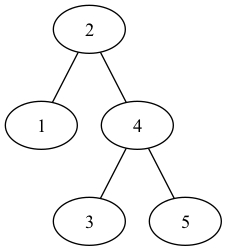
12.3-5
SEARCH(T, k)
    x = T.root
    while x != NIL and x.key != k
        if x.key > k
            x = x.left
        else x = x.right
    return x

INSERT(T, z)
    y = NIL
    x = T.root
    pre = NIL
    while x != NIL
        y = x
        if z.key < x.key
            x = x.left
        else pre = x
             x = x.right
    if pre != NIL
        pre.succ = z
    if y == NIL
        T.root = z
    else if z.key < y.key
        y.left = z
        z.succ = y
    else y.right = z
         z.succ = y.succ

PARENT(T, z)
    x = T.root
    y = NIL
    while x != NIL and x.key != z.key
        y = x
        if z.key < x.key
            x = x.left
        else x = x.right
    return y

PREDECESSOR(T, z)
    if z.left != NIL
        x = z.left
        while x.right != NIL
            x = x.right
        return x
    x = T.root
    y = NIL
    while x != NIL and x.key != z.key
        if z.key < x.key
            x = x.left
        else y = x
             x = x.right
    return y

TRANSPLANT(T, u, v)
    x = T.root
    p = PARENT(T, u)
    pre = PREDECESSOR(T, u)
    if p == NIL
        T.root = v
    else if u == p.left
        p.left = v
    else p.right = v
    if v != NIL
        v.succ = u.succ
    if pre != NIL and pre != v
        pre.succ = v

TREE-DELETE(T, z)
if z.left == NIL
    TRANSPLANT(T, z, z.right)
else if z.right == NIL
    TRANSPLANT(T, z, z.left)
else y = z.succ
     if y != z.right
         TRANSPLANT(T, y, y.right)
         y.right = z.right
     TRANSPLANT(T, z, y)
     y.left = z.left
     pre = PREDECESSOR(T, z)
     if pre != NIL
         pre.succ = y
12.3-6
Below is the modified TREE-DELETE' to choose the predecessor rather than
the successor.
TREE-DELETE'(T, z)
    if z.left == NIL
        TRANSPLANT(T, z, z.right)
    else if z.right == NIL
        TRANSPLANT(T, z, z.left)
    else y = TREE-MAXIMUM(z.left)
         if y.p != z
             TRANSPLANT(T, y, y.left)
             y.left = z.left
             y.left.p = y
         TRANSPLANT(T, z, y)
         y.right = z.right
         y.right.p = y
We could implement a fair strategy, giving equal priority to predecessor and
successor, by randomly choosing from the original TREE-DELETE procedure and
the modified TREE-DELETE' procedure.